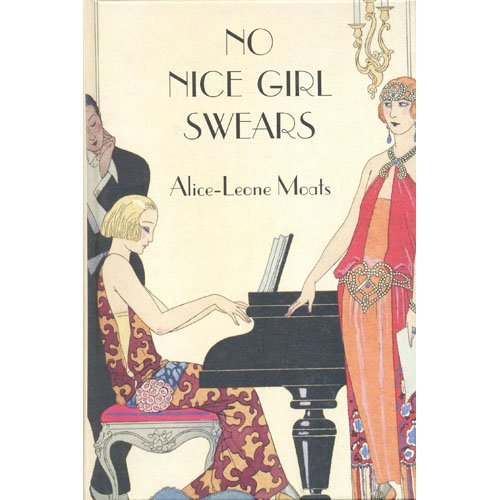
No nice girls swear
Almost ninety years after its original publication in 1933, the instant- best-selling No Nice Girl Swears is an illuminating and often hilarious guide to jazz-age America, complete with wisdom and witticisms that give new insight into the morals and manners we still hold sacred—or suspect—today.
Once heralded as the go-to guide for soon-to-be debutantes, No Nice Girl Swears shocked—and delighted—the high-society crowd it addressed. Rich with practical tips and sometimes controversial savvy, worldly-wise socialite and brazen wit Alice-Leone Moats’s no-nonsense, tongue-in-cheek guide to the social mores of the upper-crust is equal parts time-capsule (how to dress for dinner on your transatlantic voyage) and timeless missive (how to ditch a date who’s had a few too many). With a prescient eye and pithy clarity, Moats weeds through the dos and don’ts of weddings, weekend trips, and the workplace.
Nice girls have grown into strong women, but we sometimes need help navigating relationships, special occasions, and expectations. With this easily digestible volume of tips, tools, and tough love, today’s readers can track shifts in etiquette through the times and discover the quirky and unexpected origins of hard and fast social rules. Moats’s wisdom, though steeped in the charm of her time, endures: treat others—and yourself—with respect, send thank-you notes (right away!), and don’t throw a party without champagne. It’s just good manners.
Born in Mexico in 1915 as the only child of wealthy and prominent American parents, Alice-Leone Moats was educated at Manhattan’s Brearly School, the Fermata School for Girls in Aiken, South Carolina, and Oxford University, where she spent three days. As a young woman, Moats, fluent in five languages, danced in debutante balls and mingled with high-society.
Moats was commissioned to author No Nice Girl Swears in 1933, which met great acclaim and heralded the beginning of her illustrious writing career. She published prolifically as a foreign correspondent for Collier’s magazine in Japan, China, and the former Soviet Union and was a columnist for the Philadelphia Inquirer. Over her lifetime, she authored nine books. Moats died in Philadelphia in 1996 at the age of eighty-one.
EXCERPTS…
“The dance floor is the one place where it is unforgivable for either a woman or a man to carry a lighted cigarette. This last, however, has nothing to do with etiquette—it’s merely a measure of safety, for it is too simple to ignite your partner (don’t misunderstand) or set a diaphanous dress ablaze.”
“The technique of warding off passes is one which every girl should perfect…Of course, if you never wish to see the man again, you can use the direct rebuff, or the kicking and screaming method. But even that fails if you happen to draw a rough-and-tumble type.”
“It is quite proper to meet a young man at a cocktail party and go on to dinner with him. If he is attractive, you can consider yourself not only correct, but lucky.”
“It is sad but true that the more amusing the young man, the less apt he is to telephone a girl after their first meeting. For some reason the dull are always bolder.”
“While we’re on the subject of dates, we might as well go into the “blind” variety. It is not good form or lack of it that should worry you in accepting a blind date—it’s the risk you run of being bored to death.”
“A coming-out tea is very pleasant if a debutante is to have a dinner or a dance also given in her honor. Both a luncheon and a tea are recognized as legitimate ways of coming out, but they don’t make much effect. They’re boring, and nobody is grateful for being bored or feels indebted to a hostess who has given a dull party.”
“All eyes are upon an engaged couple, for everybody is interested in them; so they should try to assume the right manner. This is no easy task, as they must register devotion without being so stickily sentimental that they bore and embarrass everybody around them.”